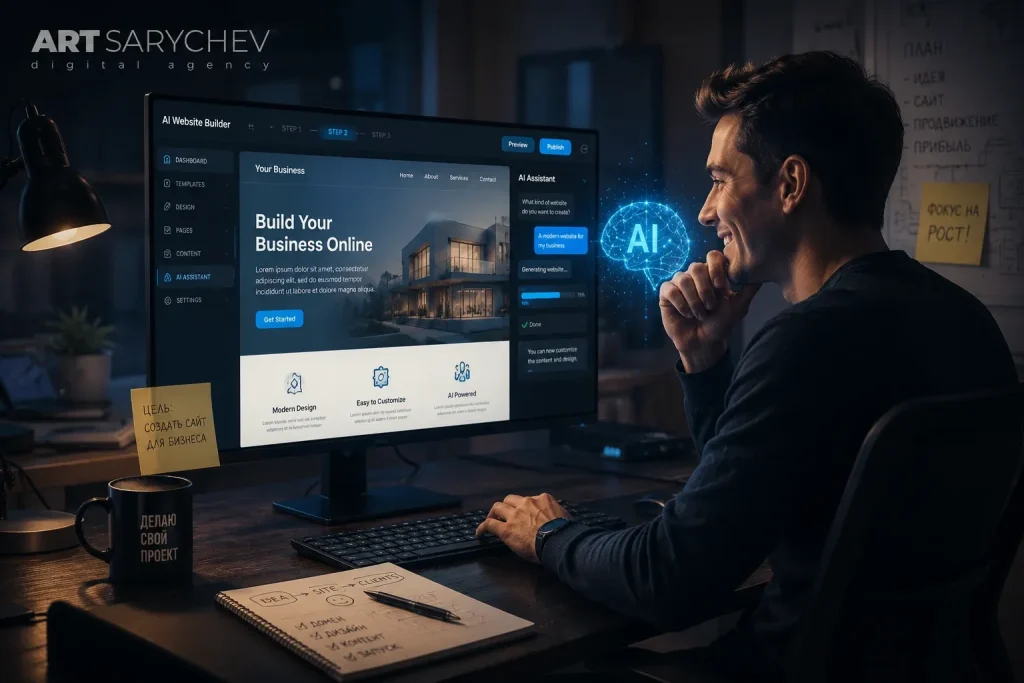
Modern business is changing fast, and traditional sales methods are giving way to digital solutions. The question of how a company website can replace a sales manager is especially relevant in 2025. Advanced technologies of artificial intelligence, machine learning and automation make it possible to build web resources that do not just inform about products and services, but actively sell, advise customers and guide them through the whole buying journey.
Why companies are massively moving to sales automation through their website
The economic realities of 2025 make entrepreneurs reconsider their cost structure. Keeping a sales team requires substantial costs: salaries, bonuses, training, office expenses. At the same time, managers’ performance often depends on the human factor — mood, fatigue, personal problems.
A website works around the clock with no days off or sick leave. It needs no motivation, does not leave for competitors and does not ask for a raise. Statistics show that a properly configured corporate website can handle dozens of times more potential customers than one manager in a working day.
Modern consumers have changed their behaviour. Most buying decisions are made after studying information online on their own. People do not want to deal with pushy sellers — they prefer to get information at their own pace and in a format that suits them.
Key features of a website that replaces a sales manager
Smart chatbots and virtual consultants
The technologies of 2025 make it possible to build chatbots that hold full conversations with website visitors. Modern AI assistants analyse the customer’s needs, ask clarifying questions, offer suitable solutions and even handle objections.
A virtual consultant can work with voice, recognise emotions in text and adapt its communication style to a specific user. It remembers the history of interactions and uses it to personalise the next contacts.
Dynamic content personalisation
A smart website tracks visitor behaviour and adapts content to their interests. If a user spends a long time studying a certain product category, the system automatically shows them relevant offers, reviews and comparison tables.
Personalisation works on many factors: location, time of visit, device, traffic source, previous actions on the website. This gives every visitor a unique experience of interacting with the brand.
Automated sales funnels
A modern website can guide a customer through the whole journey from first getting to know the brand to making a purchase and after-sales service. Automated scenarios include:
- Capturing contacts with lead magnets and useful content
- Delivering information step by step through email sequences
- Abandoned cart reminders
- Personal offers based on preferences
- Loyalty programmes and referral systems
Breakthrough technologies of 2025 for replacing managers
Artificial intelligence has reached the level where it can analyse tone of voice, facial expressions (through a webcam), pauses in speech and other non-verbal signals. This makes it possible to tell when a customer is ready to buy and choose the best moment for an offer.
Predictive analytics helps predict customers’ needs even before they realise them. The system analyses the behaviour patterns of similar users and offers solutions proactively.
Augmented reality lets customers “try on” a product and see how it will look in their interior or on themselves. This is especially effective for selling furniture, clothing, cosmetics and cars.
Voice assistants are built into websites, letting users ask questions by voice and get detailed answers. This is convenient for people who prefer speaking to typing.
Putting it into practice: a step-by-step plan to transform a website
The first stage is an in-depth analysis of current sales processes. You need to record which questions customers ask most often, which objections they raise and at what stage they most often abandon a purchase.
The second stage is building a knowledge base and scenarios. All the experience of the company’s best managers should be structured and turned into a digital format. This includes sales scripts, answers to frequent questions and objection-handling techniques.
The third stage is technical implementation. Choosing a chatbot platform, setting up the personalisation system, integrating with the CRM, setting up analytics and A/B testing.
The fourth stage is training and optimisation. Artificial intelligence needs constant training on real conversations with customers. It is important to analyse effectiveness regularly and adjust the algorithms.
Measuring the effectiveness of a digital salesperson
The key success metrics of a selling website differ fundamentally from ordinary traffic figures. It is important to track:
- Visitor-to-lead conversion — the percentage of users who left their contact details
- Time to first purchase — how much time passes from the first visit to the order
- Average order value and repeat purchases — indicators of customer lifetime value
- Lead quality — the percentage of leads who become real buyers
- Customer satisfaction — ratings of online consultations
Modern analytics systems make it possible to track every user action and link it to the final result. This makes it possible to determine exactly which website elements work well and which need improvement.
Limitations and areas where people are still irreplaceable
Despite the rapid development of technology, there are niches where live communication remains critical. This applies to complex B2B sales with a long decision-making cycle, selling expensive goods that need an individual approach, and working with large corporate clients.
In such cases the website should work together with managers, taking on the initial qualification of leads, providing basic information and preparing the customer for a personal meeting.
The future belongs to hybrid models, where digital and human resources complement each other to create the most effective sales system.
Turning a website into a full-fledged sales manager is not just a technology trend, but an objective necessity for business competitiveness in 2025. Companies that master these technologies first will gain a significant market advantage, cutting sales costs and making sales more effective.